Divorce in Austria or Italy: Splitting a Swiss Pension Fund Afterward – What Rights Do You and Your Ex-Spouse Have?

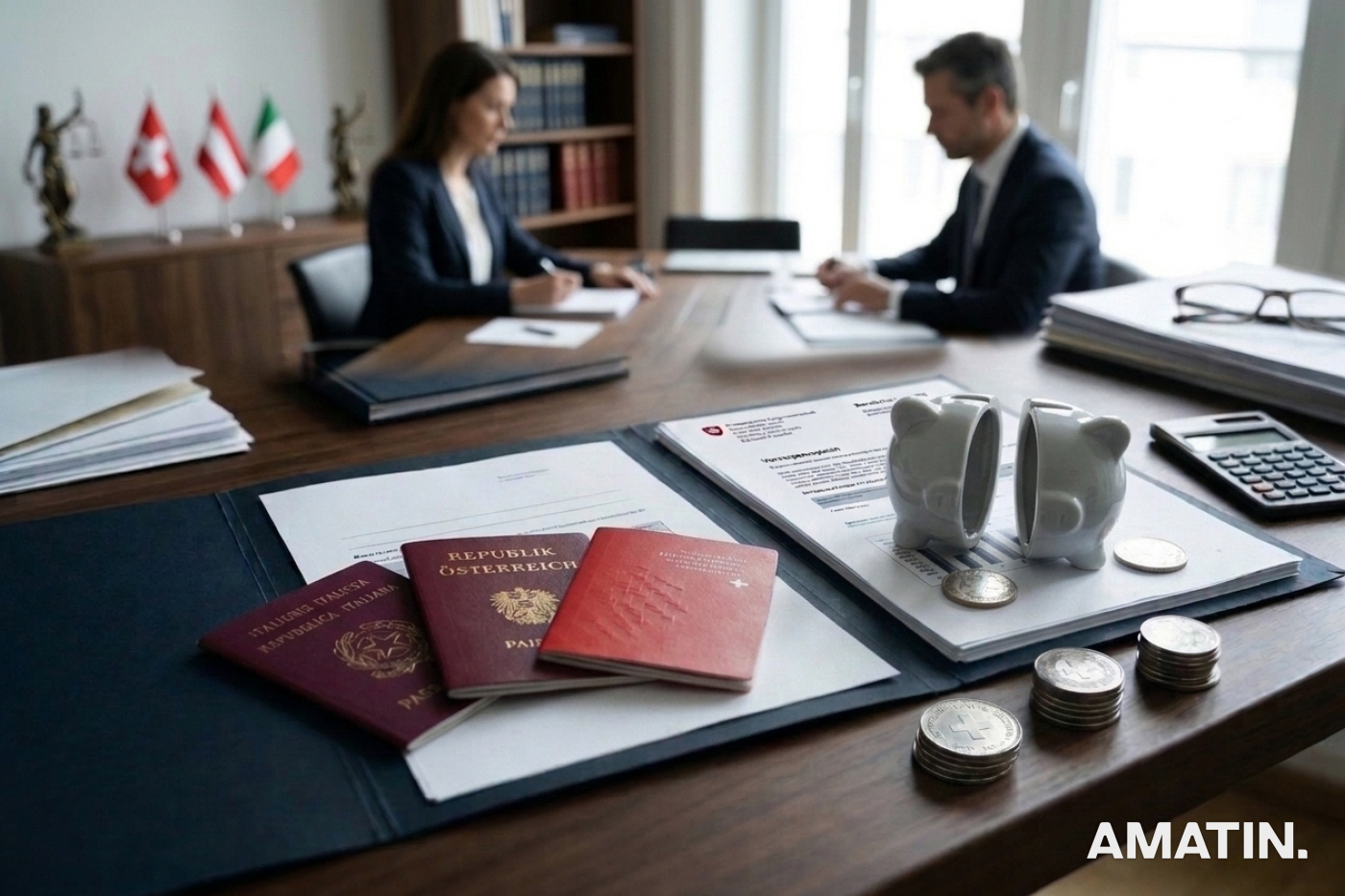
You worked in Switzerland during your marriage and built up savings in a pension fund. But your divorce took place in Austria or Italy. Now you are wondering what happens to that Swiss pension capital. Or the reverse: can your ex-spouse still claim a share of your occupational pension years after the divorce? These questions concern many cross-border commuters and people who have moved to or from Switzerland. The answer is often surprising. As a rule, a foreign divorce judgment does not divide Swiss occupational pension assets. The division must be obtained afterward in Switzerland. This article explains how that works, for both sides: for people who may still hold a claim, and for people whose pension assets may be divided after the fact.
Pension equalization concerns occupational pension provision, known in Switzerland as the 2nd pillar. Over their working lives, employees build up savings in a pension fund together with their employer. These savings are meant to provide income in old age.
In a Swiss divorce, a clear principle applies. The pension capital accumulated during the marriage is divided equally. In principle, each spouse is entitled to half of what was built up during the marriage. The reasoning is straightforward. Often one spouse works full time and accrues pension rights, while the other looks after the household and children and pays little or nothing into a pension fund of their own. The division is meant to offset that imbalance.
Since January 1, 2017, only Swiss courts may order the division of a Swiss pension fund. Only a Swiss court can instruct the pension institution to transfer the assets.
This means that a court in Austria or Italy cannot validly dispose of your Swiss pension capital. Even if the foreign divorce judgment contains a provision on dividing the Swiss 2nd pillar, Switzerland does not recognize or enforce it.
Neither Austrian nor Italian divorce law knows Swiss pension equalization in this form. Both countries treat pension entitlements differently from Switzerland. As a result, the Swiss pension fund usually remains untouched in the foreign proceedings and often does not appear in the judgment at all.
Consequently, many people who divorced abroad have simply not yet settled the equalization of their Swiss 2nd pillar, without knowing it.
Before a Swiss pension fund can be divided, the divorce itself must be valid for Switzerland. In practice, recognition of Austrian and Italian divorces is usually unproblematic, provided the judgment is final and binding and no grounds for refusal exist. The distinction between the divorce and the pension matters here. Recognition concerns the divorce as such. It does not automatically mean that the occupational pension was divided as well. Dividing the Swiss pension fund is a separate, additional step.
If the foreign judgment did not divide the Swiss 2nd pillar, the omission can be remedied through what is known as a supplementary action (Ergänzungsklage). With this action, one party asks a Swiss court to order, after the fact, the pension equalization that the foreign proceedings did not settle.
The Swiss court then examines whether, and to what extent, a right to division exists. The basis is the pension capital accumulated in Switzerland during the marriage. The relevant period runs from the wedding until the foreign divorce proceedings became pending (the point at which the case is formally submitted to the court).
Several connecting factors can establish jurisdiction, for example the residence of a party in Switzerland or the seat of the pension institution concerned. Which court is competent in a given case depends on the circumstances.
If the former spouses agree on dividing the Swiss pension capital afterward, they do not necessarily have to go through contested court proceedings. Together, they can have an agreement on the subsequent pension equalization drawn up. It specifies in particular which amount is to be transferred from which pension institution to which pension institution or vested benefits institution (a institution that holds pension assets outside an employer’s pension fund).
The agreement can then be submitted to the competent court for approval within the Swiss supplementary proceedings. The court checks whether the agreement meets the statutory requirements and can be approved. In some cases, this makes it considerably simpler and more consensual to obtain the pension equalization after the fact.
The subsequent division always affects two parties, and different questions arise depending on your role. If you built up little or no pension of your own during the marriage while your ex-spouse saved capital in Switzerland, you may be entitled to a share of it. This claim remains even if the foreign divorce took place years ago and the judgment is silent on the Swiss pension fund.
Conversely, if you built up Swiss pension capital yourself, your ex-spouse may be able to claim part of it afterward. Anyone who assumes that the foreign divorce settled everything may be surprised.
A clean separation is essential. In principle, the Swiss court equalizes only the pension capital built up in Switzerland during the marriage. As a rule, the Swiss court does not divide pension entitlements that exist abroad.
If the parties made an agreement on occupational pension in the foreign proceedings, you need to examine closely what it actually covers. Sometimes the Swiss 2nd pillar was deliberately excluded, sometimes it was overlooked by mistake, and occasionally an agreement contains a waiver.
Under Swiss law, a waiver of pension equalization is valid only under narrow conditions. In particular, it must ensure that adequate old-age and disability provision remains guaranteed. Whether an arrangement made abroad meets these requirements cannot be answered in general terms and must be assessed case by case.
Many people ask whether they have waited too long. For supplementing a foreign divorce judgment on occupational pension, there is no short forfeiture period (a strict deadline after which the right lapses) in the usual sense. Even so, you should act promptly, for several reasons.
The longer ago a divorce took place, the harder it becomes to reconstruct the relevant pension balances. In addition, the pension situation can change considerably through retirement, a lump-sum withdrawal or death. Such developments can complicate the equalization or affect its amount.
Suppose a couple marries and lives in Austria for several years, while one spouse works in Switzerland as a cross-border commuter and pays contributions into a Swiss pension fund. After the separation, the divorce is granted by an Austrian court. The judgment settles maintenance and matrimonial property, but does not mention the Swiss pension fund at all.
Years later, the other spouse learns that they may be entitled to half of the pension capital built up in Switzerland during the marriage. Through a supplementary action before the competent Swiss court, this equalization can be claimed after the fact. The example shows both perspectives. For one side, a valuable claim arises; for the other, an unexpected obligation.
Have your situation reviewed early, before retirement or a lump-sum withdrawal changes the starting position. First, establish whether the foreign divorce is recognized in Switzerland and whether the Swiss 2nd pillar was in fact divided in the judgment. Obtain the divorce judgment, any agreement and the documents from your pension institution. On that basis, you can assess whether a supplementary action makes sense and has good prospects, whether you want to assert claims or protect yourself against them. The outcome always depends on the individual case. We would be glad to review your documents, clarify jurisdiction and support you through the subsequent division.
Contact our professional experts

roman.kaelin-burgy@amatin.ch
+41 61 202 91 99
© 2023 Amatin AG